There is a pattern I have observed across dozens of corporate drinkware gift programmes that consistently produces the same outcome: a product that every internal stakeholder has approved, yet no recipient particularly values. The pattern is not caused by poor taste or insufficient budget. It is caused by the structure of the approval process itself — specifically, the way sequential sign-off layers interact with each other when selecting which types of corporate drinkware gifts are appropriate for a given business need.
The typical approval sequence for a corporate gift programme runs through four or five internal functions. Procurement initiates the brief and shortlists suppliers. Marketing reviews the shortlist for brand alignment. Finance evaluates unit cost against the allocated budget. Compliance checks the proposed items against the organisation's gift policy and, in the UK context, against HMRC trivial benefits thresholds and Bribery Act exposure. Each function applies its own filter. Each filter is individually rational. But the cumulative effect of running a product selection through four sequential filters is that the final choice represents the intersection of all constraints rather than the optimal solution for any single objective.
What makes this process particularly damaging for drinkware gifts is that the attributes most likely to be filtered out are precisely the ones that create genuine recipient value. Consider what happens when procurement shortlists three options: a standard ceramic mug at £5, a quality insulated bottle at £10, and a premium gift set with custom packaging at £16. Procurement's brief typically specifies quantity, maximum unit cost, and delivery timeline. The shortlist is reasonable. But when marketing reviews the options, they focus on logo placement area, colour matching to brand guidelines, and visual consistency across the range. The gift set's custom packaging — which is the single strongest driver of perceived value — may be flagged because the packaging colour cannot precisely match the Pantone specification in the brand book. Marketing does not reject the gift set outright, but they note the colour deviation as a concern. When finance reviews the flagged options, they see a £16 item with a noted brand concern versus a £10 item with no flags. The financial logic is straightforward: why pay 60% more for an item that marketing has already questioned? The insulated bottle advances. When compliance reviews the remaining option, they confirm it falls within the trivial benefits threshold and presents no Bribery Act exposure. The insulated bottle is approved.
The outcome is a perfectly defensible decision. Every stakeholder signed off. Every filter was applied correctly. But the product that would have created the strongest brand impression — the gift set with custom packaging — was eliminated not because anyone rejected it, but because each layer's marginal concern compounded into a decisive disadvantage. This is what I mean by the lowest-common-denominator effect in corporate gift selection.
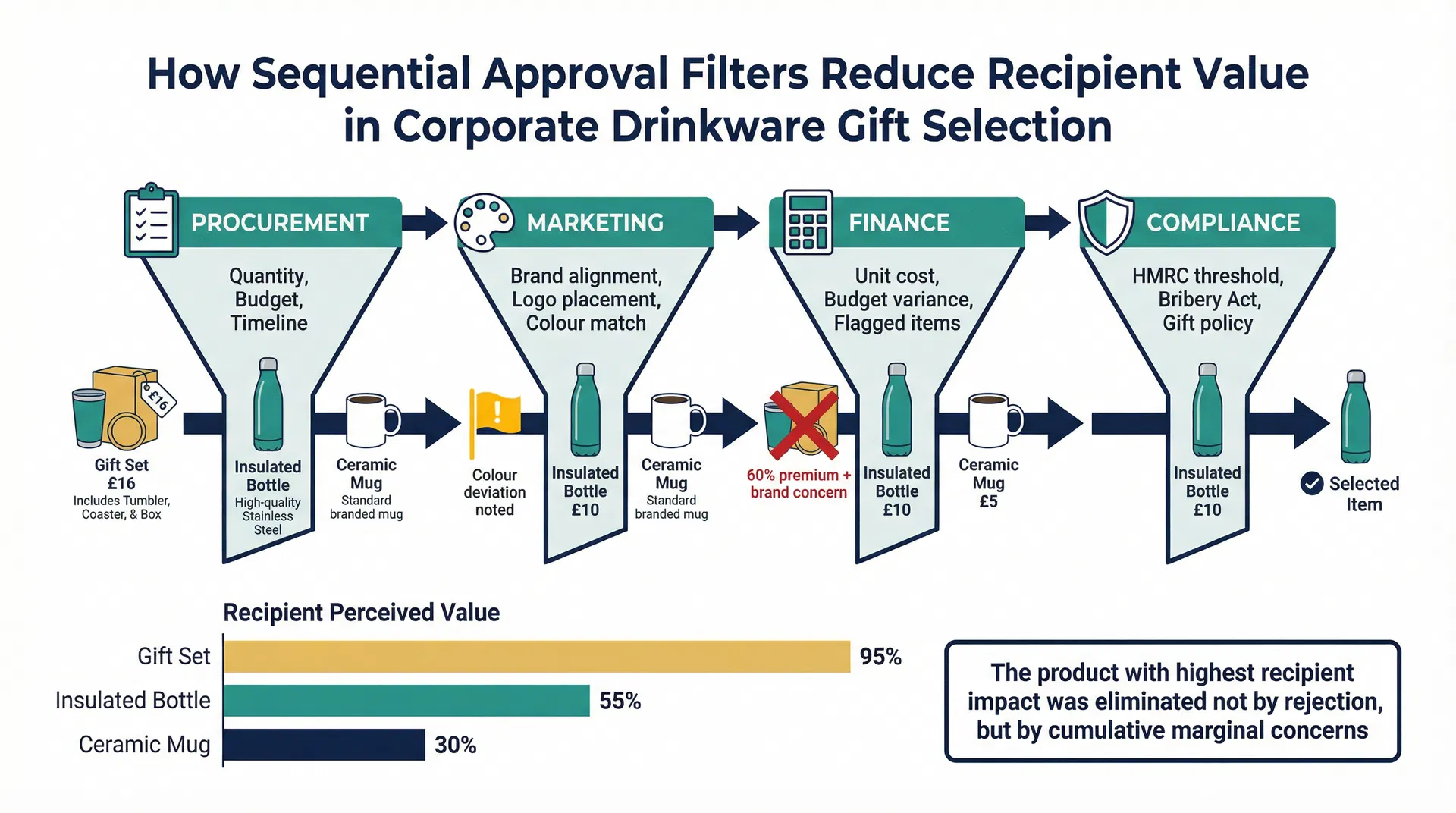
In practice, this is often where corporate drinkware gift decisions begin to be misjudged — not at any single approval stage, but in the interaction between stages. The problem is structural. Each approver evaluates the shortlist against their own department's criteria without visibility into how their assessment interacts with assessments from other functions. Marketing does not know that their colour-match concern will be interpreted by finance as a cost-reduction opportunity. Finance does not know that the £6 saving per unit will eliminate the packaging element that drives 40-60% of the recipient's perceived value. Compliance does not know that the surviving option, while fully compliant, is also the option least likely to be kept and used by the recipient.
The factory side sees this pattern repeatedly. A client's procurement team sends a brief requesting 500 insulated bottles with laser engraved logos, delivery in eight weeks. The brief is clean, the specifications are clear, and the production timeline is achievable. But when I ask how the product was selected — why insulated bottles rather than ceramic mugs or gift sets — the answer is almost always some variation of "that's what was approved." Not "that's what our recipients prefer" or "that's what creates the strongest brand impression for this audience." The selection rationale has been compressed through the approval chain until only the procedural justification remains.
The practical consequence is that organisations spend their corporate gift budgets on products that satisfy internal governance requirements but underperform on the only metric that ultimately matters: whether the recipient keeps the item, uses it regularly, and associates it positively with the gifting organisation's brand. A broader examination of which types of corporate drinkware gifts suit different UK business needs reveals that the most effective programmes are those where the selection criteria are weighted toward recipient utility and perceived value rather than internal process convenience.
The correction is not to bypass the approval chain — every function's input is legitimate and necessary. The correction is to restructure the evaluation so that recipient-impact criteria carry explicit weight at every stage, rather than being implicitly deprioritised by each successive filter. When procurement writes the initial brief, recipient context should be specified alongside quantity and budget. When marketing reviews options, brand alignment should be assessed against the recipient's experience of the product, not just the visual appearance in a catalogue photograph. When finance evaluates cost, the comparison should include estimated cost-per-active-brand-impression rather than unit cost alone. When compliance reviews the final selection, they should confirm not only that the item is within policy limits but that the item's value positioning is appropriate for the specific recipient relationship.
The programmes that consistently deliver the strongest outcomes are those where the approval chain operates as a parallel evaluation rather than a sequential filter. Each function scores the shortlisted options against its own criteria, and the final selection is the option with the highest aggregate score — not the option that survived every individual veto. This approach preserves governance and accountability while preventing the systematic erosion of recipient value that sequential approval creates. It requires slightly more coordination, but the difference in programme effectiveness is substantial enough that the additional process cost is recovered many times over in brand impact.