There is a procurement pattern that surfaces in nearly every corporate drinkware gifting programme that has been running for more than two years. The team responsible for ordering looks at the previous year's purchase order, confirms that the product performed adequately, adjusts the quantity, and resubmits. The supplier is familiar. The approval path is clear. The unit cost may even improve slightly on a repeat run. From a procurement efficiency standpoint, this is textbook execution.
The problem is that efficiency in ordering and efficiency in brand impact are not the same metric, and the gap between them widens with each annual cycle.
When a recipient receives a branded stainless steel water bottle for the first time, the object carries novelty. It is examined, tested, placed on a desk or taken to a gym. The logo is noticed. The weight and finish are assessed. Industry data suggests that a single piece of branded drinkware generates over three thousand impressions across its usable life, and that figure is built almost entirely on the assumption that the item is new to the recipient. What the data does not capture is what happens when the same person receives a nearly identical bottle the following December.
The behavioural science behind this is well documented outside the gifting context. Novelty triggers a measurable dopamine response — the brain registers something unfamiliar and pays closer attention. Repeated exposure to the same stimulus reduces that response. In advertising, this is called wearout. In promotional merchandise, the effect is the same but less visible because no one tracks it. The bottle arrives, it is acknowledged, and it is placed alongside last year's version. Usage does not double. Impressions do not compound. The second bottle simply dilutes the perceived thoughtfulness of the gesture.
This is where the disconnect between procurement logic and brand intent in corporate gifting programmes becomes most apparent. Procurement teams are rewarded for reducing friction. Reordering the same product from the same supplier is the lowest-friction path available. But the brand team — if they are consulted at all — needs the gift to generate a fresh signal. These two objectives are structurally incompatible when the product remains unchanged year after year.
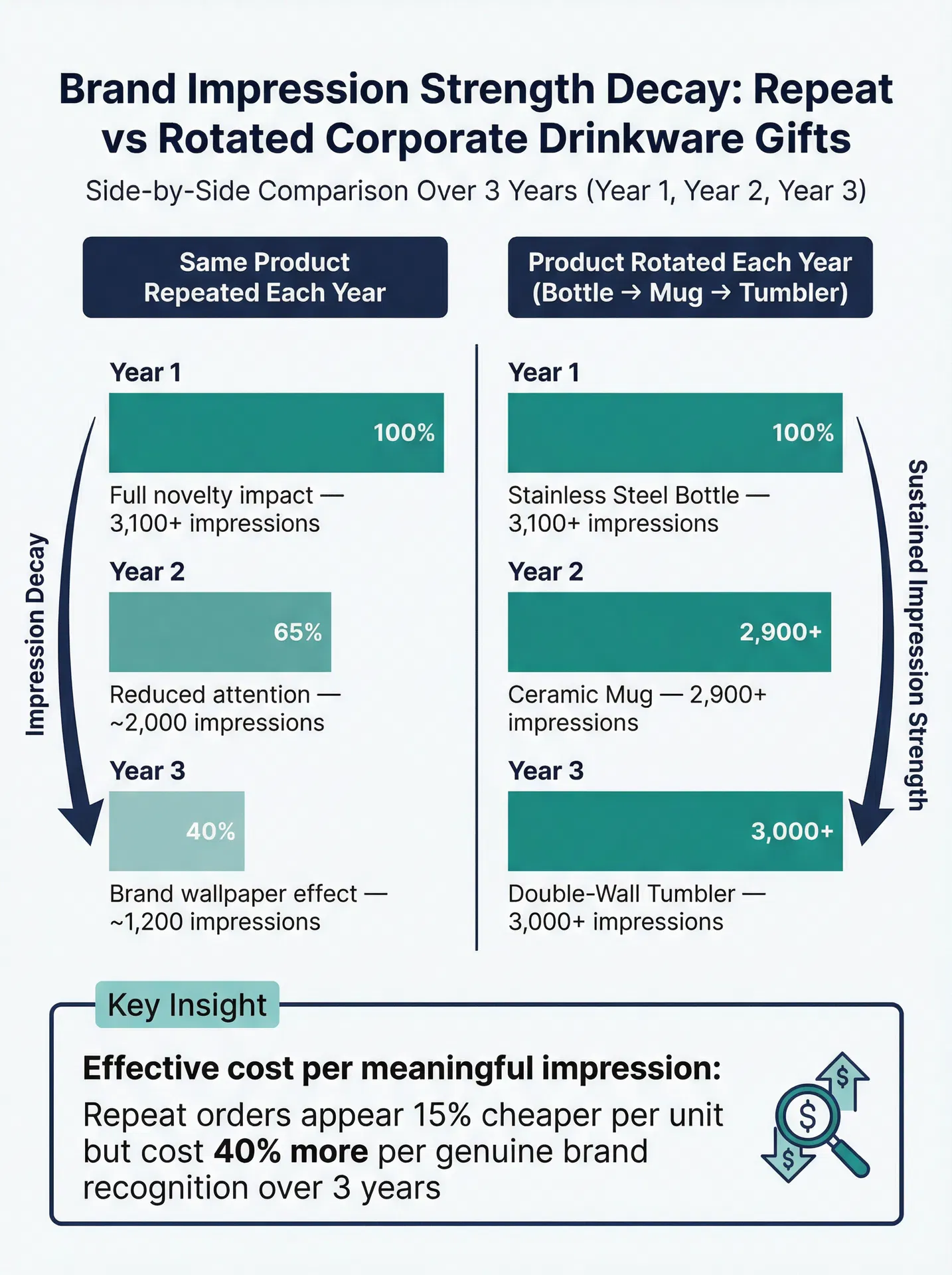
The cost implications are counterintuitive. A repeat order typically costs less per unit than a new product specification. But if the meaningful impression rate drops by even a third on the second cycle and by half on the third, the effective cost per impression rises sharply. A programme that appears to be saving fifteen percent on unit cost may actually be spending forty percent more per unit of genuine brand recognition. No procurement report captures this because the metric does not exist in most organisations' tracking systems.
There is a related operational assumption that compounds the issue. Teams often believe that switching products introduces unacceptable risk — new sampling cycles, untested decoration methods, potential quality variance. These concerns are legitimate in isolation but overstated in context. A supplier capable of producing a laser-engraved stainless steel bottle to specification one year can produce a ceramic mug or a double-wall tumbler to equivalent standards the next. The manufacturing capability is not product-specific. What changes is the internal effort required to approve a new item, and that effort is precisely what procurement processes are designed to minimise.
The practical consequence is that many UK corporate gifting programmes operate in a cycle where the first year generates genuine brand value, the second year generates diminishing returns, and the third year produces what might be described as brand wallpaper — present but no longer noticed. Recipients who receive the same branded drinkware item three years running do not think more highly of the brand. They think less about it altogether.
Rotating the product category within the drinkware range — shifting from bottles to travel mugs, from mugs to flasks, from flasks to tumblers — preserves the novelty signal without requiring a complete programme redesign. The supplier relationship can remain stable. The decoration method may carry over. The budget envelope stays intact. What changes is the physical object, and that change alone is sufficient to reset the recipient's attention and restore the impression value that repetition erodes.
The organisations that extract the most brand value from their drinkware gifting programmes are not necessarily spending more. They are spending differently each cycle. They treat the product selection as a variable rather than a constant, and they recognise that what worked last year is precisely the reason it will work less well this year. That recognition rarely originates from procurement. It requires someone in the process to understand that the gift's job is not to arrive — it is to be noticed.